The Sun Was in the Wrong Place (Apparently)
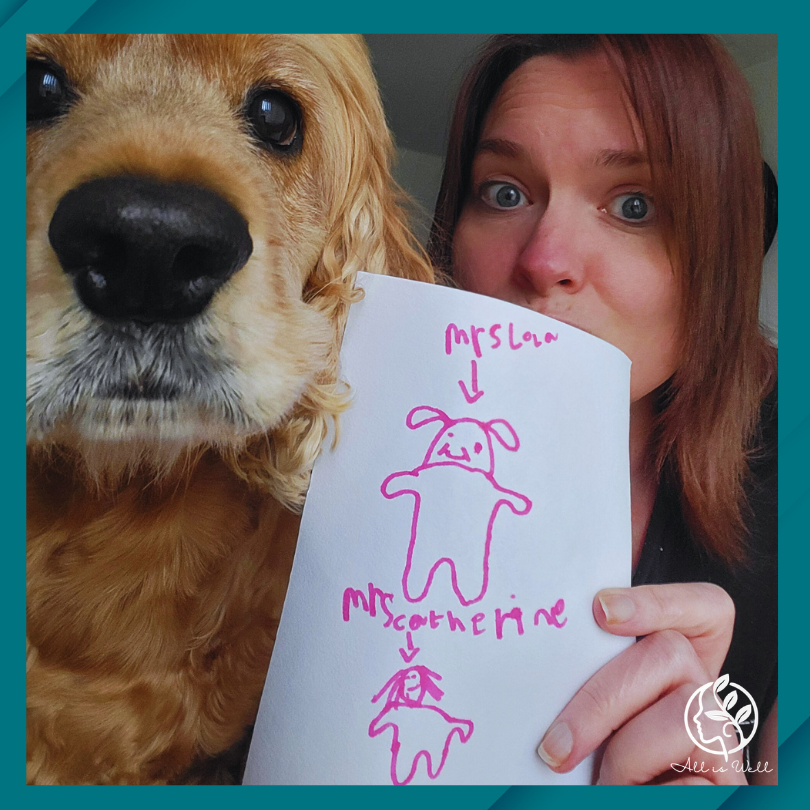
Written from my garden, where Lola is currently keeping a very close eye on a leaf that has dared to land within her general vicinity. She hasn’t moved for a solid two minutes, which suggests this is now a matter of principle.
Anyway…I was thinking about childhood memories. As you do.
I can still picture it clearly. The classroom. The noise. That slightly chaotic mix of chatter, excitement, paint pots, water pots, and the constant risk of something being knocked over at any given moment.
I was standing there, holding my picture with paint covered hands, absolutely proud of myself. Proud as punch, actually.
I even remember the teaching assistant. Her name still lives in my head, which feels slightly unfair considering she’s probably forgotten the entire interaction, so I won’t name her here.
She was doing what teaching assistants do, quietly preventing chaos, redirecting small humans away from disaster, and somehow keeping the entire room functioning through a combination of intuition, reflexes, and pure magic. And then…
…well, nothing dramatic. No one shouted. It was just a quick comment from Mrs Shall-not-be-named to inform me that my person’s anatomy was wrong, and no, the sun doesn’t stick in the corner like that. What a silly drawing I had produced. An exchange most probably forgotten the second it left her lips.
But not by me. Hence, my retelling of the tale today!
In that one moment, my incredible masterpiece, almost certainly worthy of an award, was…wrong.
Last week, I was chatting with a staff member in one of my schools and she told me a story that made me think.
She’d been ‘told off’ in High School for making bread “wrong”. (I am not a bread expert, so I’ve no idea how you even would bake it “right” or “wrong”, to be honest.)
She laughed as she told me. And then added, very casually, “I’ve never baked bread again since that day. Not once.”
Which is quite sad when you think about it. Because these moments aren’t big. They’re not dramatic. No one is setting out to knock a child’s confidence. They’re just passing comments. Quick corrections. Offhand remarks. Things said in the moment.
And yet…they stick.
Sometimes in ways we don’t even realise at the time. Like never baking bread again. Or hesitating, just for a second, before you draw something new…especially a person!
Children are constantly trying to work out ‘Am I doing this right?’ ‘Am I ok?’ ‘Is this version of me acceptable?’
And we answer those questions in a thousand tiny ways every day. Sometimes with curiosity. Sometimes with encouragement. And sometimes, without meaning to…with correction.
“Do it like this.” “No, that’s wrong.” “Not like that.”
Now, don’t get me wrong. Children do need to learn. At some point, they will discover that the sun does not, in fact, live permanently in the top corner of every scene. That arms don’t technically grow out of torsos (although some of my drawings were very convincing), and that there is a better way to bake the perfect loaf!
But there is a difference between teaching and guiding and making a child feel like they’re foolishly wrong, sometimes to the extent that they never EVER want to try again.
Because what we say doesn’t just stay in that moment. It becomes part of how they see themselves. We all absorb the things people say to us, children and adults alike. And somehow, the negatives always seem to shout the loudest.
Which is where Lola comes in. Because Lola has absolutely no concerns about artistic accuracy. She has never once looked at a drawing and thought, “Hmm…proportionally, that’s a bit off.” She doesn’t mind if the sun is in the corner, the sky is a strip, or the fingers resemble a small collection of sausages (in fact, she quite likes that idea!).
As far as Lola is concerned, every piece of work is worthy of a sniff, a gentle nudge, and, if you’re lucky, a full head-on-the-page moment of approval. She meets children exactly where they are. No judgement. No correction. No sense of “you’ve done this wrong”. She supports children’s creativity and emotional wellbeing in schools, showing them that every attempt is valued.
And what happens? Children relax. They try. They create. They talk. Because they feel safe enough to do so.
So no…this isn’t about getting everything right. That would be impossible and exhausting. It’s just about noticing. Pausing, sometimes before we correct. Offering curiosity instead of immediate judgment.
“Tell me about your drawing.” “I love how you’ve done that.” “What made you choose that?”
And yes…sometimes showing them another way. Guiding them with other examples. Gently. Kindly. Without taking away the pride in what they’ve already created. Because if the negatives can stay with us for decades, the positives can too.
So maybe this week, it’s worth thinking about the words we use. Those quick comments. Those throwaway corrections.
And offering a few more of the ones that stay for the right reasons.
*No malice or hard feelings towards the teaching assistant in question…if that little artistic incident hadn’t happened circa 1988, I wouldn’t have had a blog post to write today. So, thank you!
If this made you smile, there’s also a simple resource that connects with this idea of encouraging confidence and expression rather than correction. The Shine Bright colouring page is a gentle printable that helps children focus on self expression, calm, and confidence building through creativity. Download the Shine Bright colouring page here
If this blog post made you smile (or nod knowingly), there’s a little extra on Children and Resilience waiting for you. Click the button below for a read.
