I Didn’t Walk 1000 Kilometres…
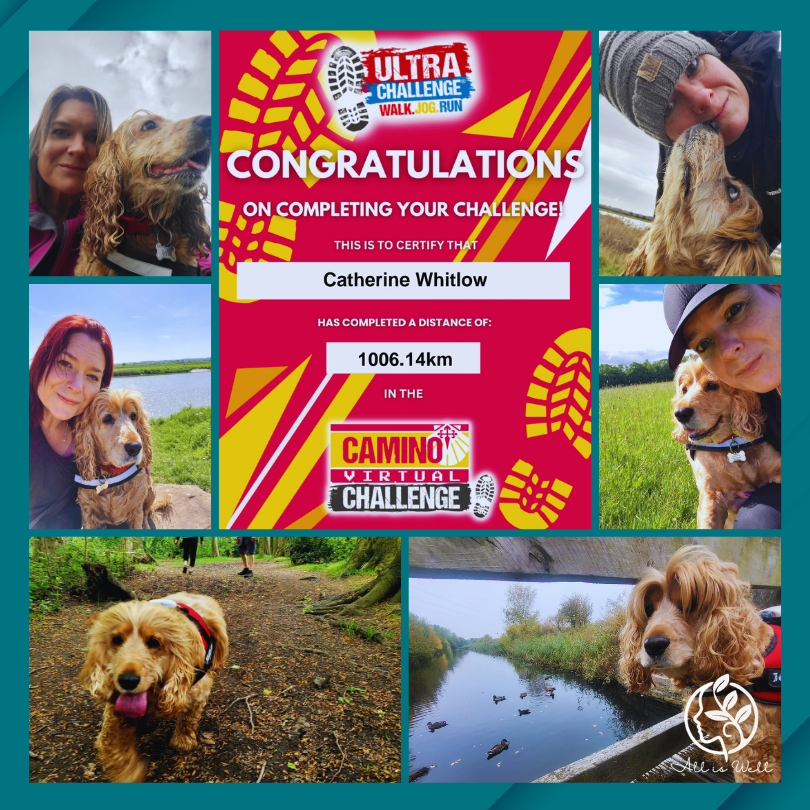
Written from my kitchen table, with a coffee going cold beside me and Lola currently lying in the middle of the kitchen floor, apparently exhausted by the sheer effort of supervising my writing.
Although, to be fair, she has just sighed loudly, repositioned herself approximately six inches to the left and gone back to sleep.
So obviously, she's had a very busy morning.
Anyway...
On Saturday, I completed a 1000km virtual walking challenge, smugly finishing ahead of the 31st August deadline.
And you’d think that means I walked 1000km. Technically, I did, but probably not in the way people imagine. I didn’t wake up one morning, look at 1000km and think, Yep. I can do that, then set off and walk it in one go. That would be slightly ridiculous, even for me.
I walked a few km. Then I walked a few more. And then I did it again the next day. And the next.
Sometimes Lola dragged me out. Sometimes I walked alone. Sometimes I walked on my treadmill with a podcast and a cup of tea. Some days I was raring to go. Some days getting a couple of kms under my belt felt like hard work. Some days I just really couldn't be bothered at all. But every single km counted.
Because I didn't walk 1000km.
I walked today's km.
Whatever my capacity allowed.
And somewhere along the way, I realised something that has very little to do with walking.
We don't always need to make the goal smaller. We need to make the step smaller.
The Problem With Looking at the Whole Journey
When I signed up to take part in the Ultra Challenge virtual walking challenge, I'll be honest: 1000km felt slightly ridiculous. My brain immediately tried to make sense of the number in a way I could understand. 1000km became 621.371 miles, which somehow didn't make it feel any more achievable. In fact, when I realised that was roughly the equivalent of walking from Liverpool to London three times, I thought, Oh. This might actually be a terrible idea.
Too big. Too far away.
I laughed at myself a little, because you can't realistically hold the whole thing in your head and feel motivated by it. You can look at a number like 1000 and immediately think, How on earth am I supposed to do that? But you can also think:
What can I manage today?
Some days, that answer is generous. Some days, it's tiny. Some days, it's simply, I'll do what I can and that's enough.
The goal didn't change on those days. My capacity did.
And the smaller effort still counted. That km didn't somehow become less valuable because I was only capable of one. It was still one km closer than I was before.
Children Know This Better Than We Do
We do the same thing to children all the time. We stare at the 1000km (read independently, write a whole paragraph, make friends, manage emotions, come into school, join the group, try something new, complete the task, catch up, become more confident) and then we wonder why the child is struggling to get started.
Maybe the useful question isn't, “How are we going to get them all the way there?”
Maybe it's “What's the first km?”
Not the whole journey. Not where we think they should be. Not where another child is. Just the next step. Something small. Something doable. Something that matches their capacity that day at that moment, not the imaginary child we hope they'll be in six months.
Because sometimes the answer isn't to lower the destination.
It's to make the distance between here and there feel possible.
And it isn't just children who need this.
We do it to ourselves too.
Starting a business. Getting through a difficult period. Changing something about ourselves. Learning something new. Getting fitter. Writing a course. Building a new service.
Sometimes we stare at the enormous end goal and feel overwhelmed before we've even taken the first step. But capacity isn't constant. Some days you have plenty. Some days you have less. Some days you have very little. That doesn't mean you've failed.
A slower day isn't a failed day.
A child doesn't move towards a goal in a neat upward line. Neither do we. Some days we take five steps forward. Some days we manage one. Some days we appear to go backwards. And sometimes one km on a really difficult day is worth far more than ten km on an easy one. Because the achievement isn't just in how far you went.
It's in what it took to take that step.
And Before Anyone Says...
“Well, you've always been good at these walking things, you’ve done them before!”
Let me remind you that last year I walked 100km non stop across the Peak District for Cancer Research, through the day and night, during one of the hardest emotional and mental periods of my life. Muscles I didn't even know existed hurt. I was so tired and delirious that I'm pretty sure the sheep were talking to me, and my poor toes had become something resembling sausages.
But I finished it.
Then I cried. Actually, I REALLY sobbed at the finish line.
And then I said to anyone who would listen…Never. EVER. Again.
Well...
Let's just say 2027 might have other ideas….Watch this space!
#AllIsWellApproach #SHINEWall #TherapyDog #ChildrensMentalHealth
